A First for the Vice Presidency: J.D. Vance’s Landmark Visit to Armenia and Azerbaijan
Recent Articles
Author: Kurtis Yan, Jack Halsey
02/12/2026
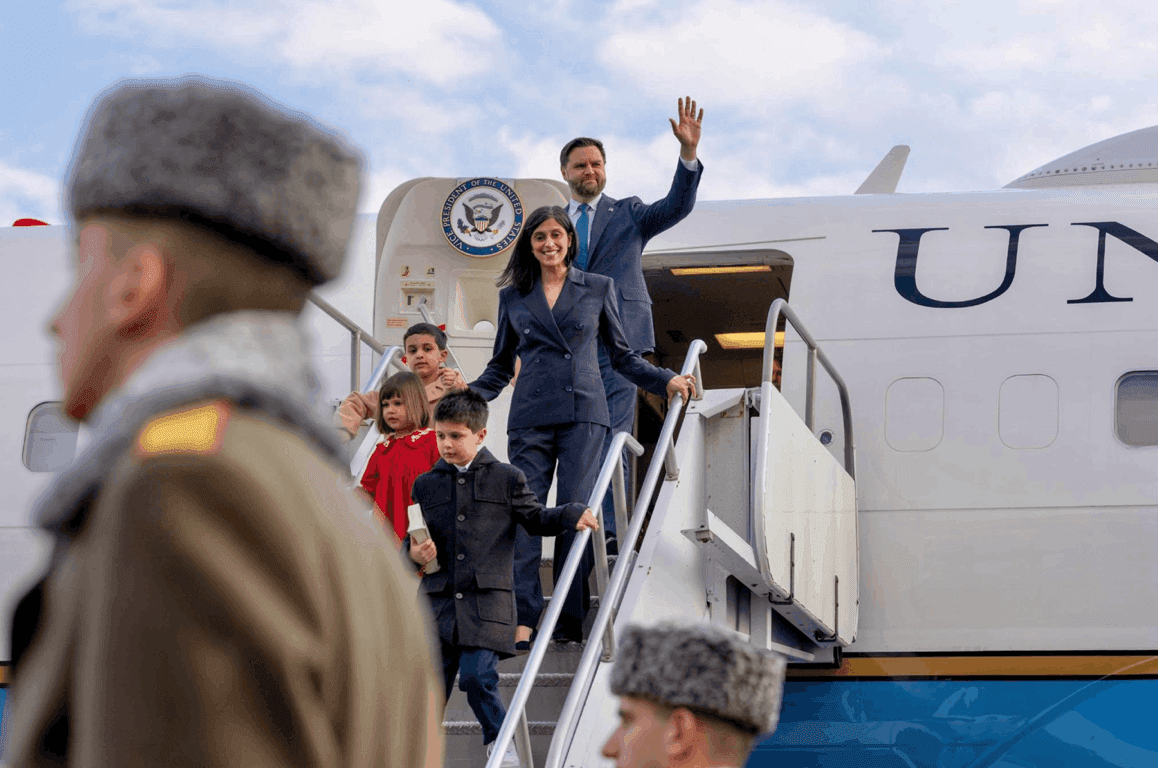
U.S. Vice President J.D. Vance’s February 9-11 visit to the South Caucasus represents an important step forward in enhancing East-West connectivity and solidifying a solid U.S. footprint in the Greater Caspian Region. As the first sitting U.S. vice president to visit either Armenia or Azerbaijan since Dick Cheney visited Baku in 2008, Vance signed several important agreements with Armenia’s Prime Minister Nikol Pashinyan and Azerbaijan’s President Ilham Aliyev. More importantly, Vance’s visits signaled a continued U.S. commitment to working with the region and the two heads of state going forward.
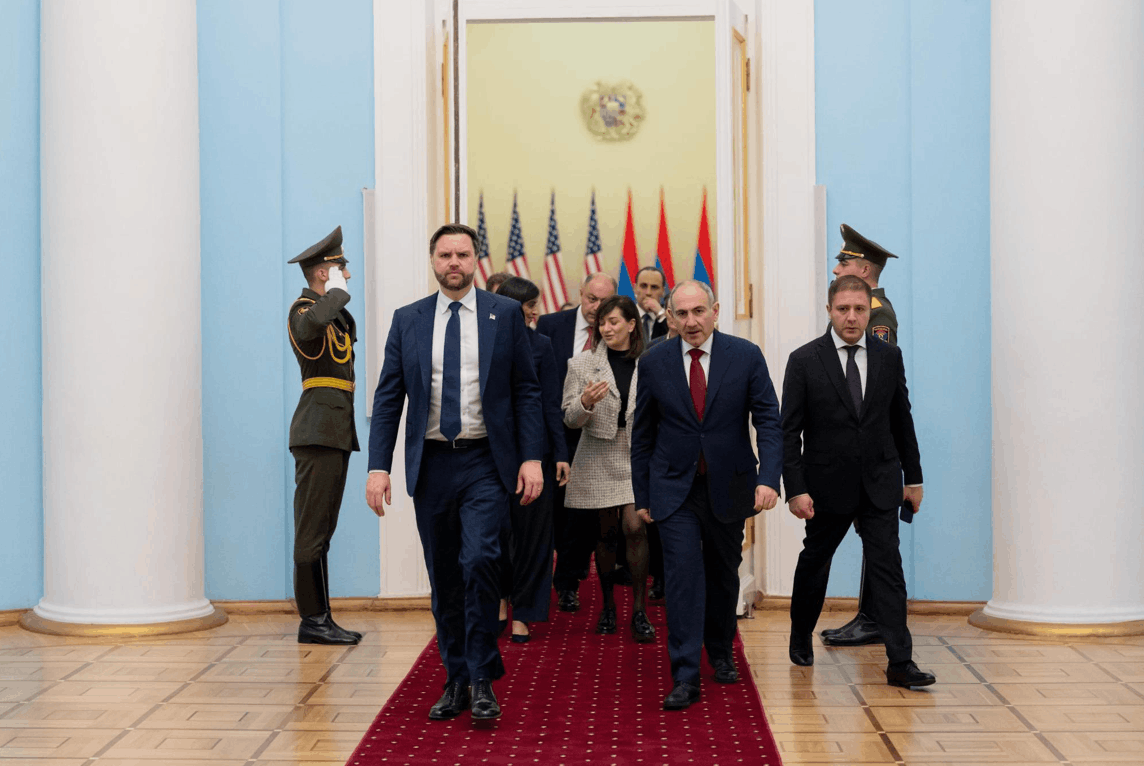 Vice President JD Vance visits Prime Minister Nikol Pashinyan in Yerevan, Armenia Source: X
Nuclear Cooperation and an Endorsement?
Perhaps most significant from Vance’s visit to Yerevan was the signing of a 123 Civil Nuclear Agreement between the two states. The agreement approves the export of U.S. nuclear materials and technologies, setting the framework for Washington to assist Yerevan in the construction of a new nuclear power plant. During its search for a replacement for the aging Soviet-built Metsamor power plant, Armenia consulted with the United States, Russia, China, France, and South Korea. However, the United States now appears to be the frontrunner, given Armenia’s preference for a small modular reactor (SMR). After signing the 123 Agreement beside Pashinyan, Vance stated that the United States will provide “up to $5 billion in initial U.S. exports, plus an additional $4 billion in long-term support through fuel and maintenance contracts.”
Building on the establishment of the TRIPP Implementation Framework (TIF) in January, both Vance and Pashinyan reiterated their commitment to enhancing connectivity through the Trump Route for International Peace and Prosperity (TRIPP). Pashinyan pointed to “feasibility studies that were launched a few days ago.” Vance emphasized that a TRIPP Enterprise Fund will facilitate unprecedented levels of trade and energy flows by funneling private capital through the construction of logistical infrastructure—namely new railroads and pipelines. Both Vance and Pashinyan stressed the significance of utilizing the TRIPP Corridor to strengthen critical-mineral supply chains across the Caspian region as well, demonstrating a clear interest in aligning mineral access with logistical capabilities.
Meanwhile, Vance announced the U.S. deployment of export licenses to authorize the sale of high-level Nvidia chips to Armenia. The announcement supports a 2025 plan to construct a new $500 million data center in Armenia that Firebird.AI will operate. On the tech and security front, the U.S. is now also set to sell $11 million in surveillance drones to Armenia, while Pashinyan highlighted the significance of bilateral security cooperation through the Eagle Partner military exercises, which both countries have held over the past three years.
When taking questions from the press, Vance also included an endorsement for Pashinyan’s reelection. Vance stated that “to the extent my endorsement means anything, he certainly has it because [Pashinyan is the one] who can build the long-term partnership to make this kind of thing stick.”
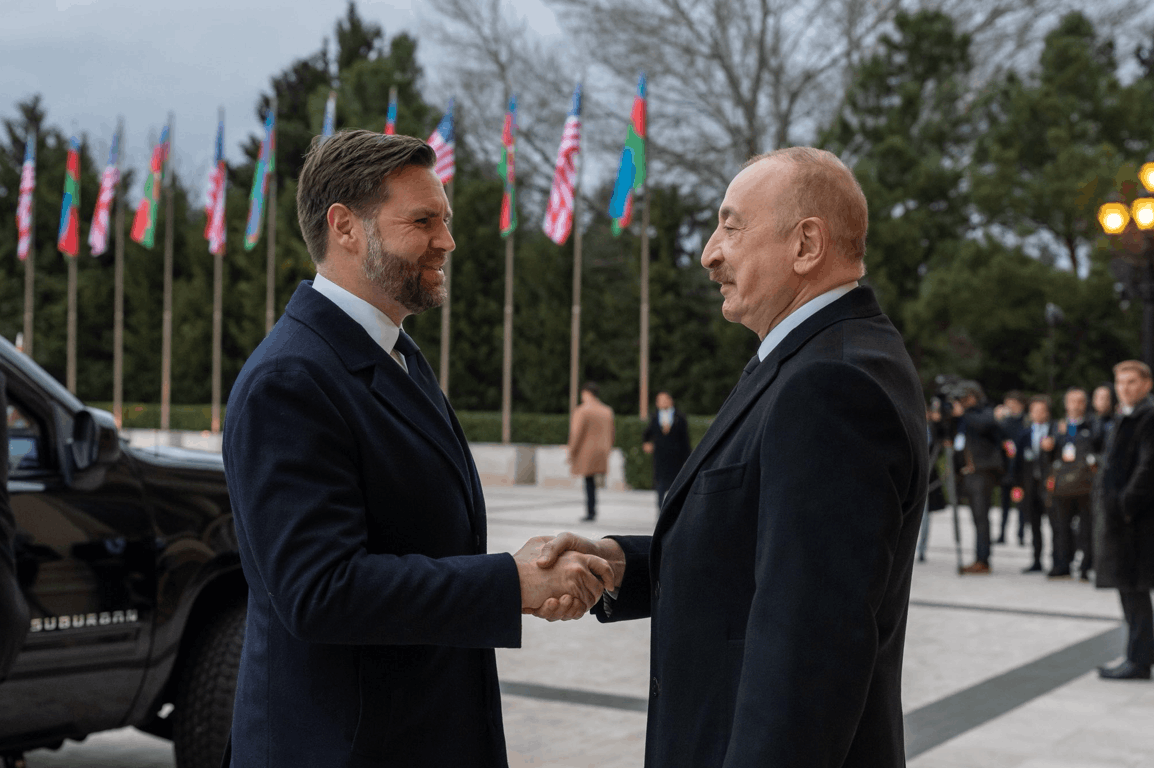 President Ilham Aliyev greeting Vice President Vance to Baku, Azerbaijan. Source: X
Strategic Partnership with Baku
After his visit to Yerevan, Vance arrived in Baku to meet with Azerbaijan’s President Ilham Aliyev. There, the parties signed a strategic partnership that signaled a strengthening of U.S.-Azerbaijan relations. The partnership agreement emphasizes cooperation on security, energy, and technology, specifically joint digital infrastructure and artificial intelligence projects. Furthermore, Vance announced that the United States would provide Azerbaijan with new patrol boats for securing its territory in the Caspian Sea.
Towards the beginning of his speech, Vice President Vance thanked and commended Azerbaijan’s support in the global war on terror. He recounted how Azerbaijani forces were some of the last to leave Afghanistan and stated that they “earned a reputation as being some of the toughest and fiercest troops anywhere in the world.” Towards the end of his speech, Vance remarked how Aliyev, much like U.S. President Donald Trump, has successfully maintained strong relations with both Israel and Türkiye.
Like Pashinyan, Aliyev also stressed the role of the TRIPP Corridor as an instrument for peace and cooperation between Armenia and Azerbaijan. He pointed out the gradual warming of relations with Armenia, as shown by oil and gas sales to Armenia and the transit of cargo through Azerbaijan and onward through Armenia. During his speech, Vance commended Aliyev and Pashinyan for their efforts to implement the August peace plan, adding that the U.S.-Azerbaijan partnership has been “underappreciated” but very important throughout its history.
Roadmap for Future Middle Corridor Investment?
Throughout the trip, Vance underlined the need to establish commerce and engagement within the region to deter any future conflicts. In Armenia, he stated, “When you create interconnected, you know, economies, energy sectors, so forth, it means that this region can have an enduring peace.” The next day in Baku, Vance added, “We know that one of the great things that can prevent fighting and prevent wars from breaking out is when two peoples culturally exchange with one another, when they spend time working with one another, and of course when they create great prosperity by working together as opposed to fighting one another.”
For the Caspian region at large, the current deal making in the South Caucasus is a potential roadmap going forward. Although Central Asia announced the $25 billion “Deal Zone” with the United States during the 2025 C5+1 Summit, there were fewer long-term investments. However, with the United States now investing time and resources into Middle Corridor infrastructure in the South Caucasus, it is reasonable to assume that investments in the corridor could continue across the Caspian and into Central Asia.